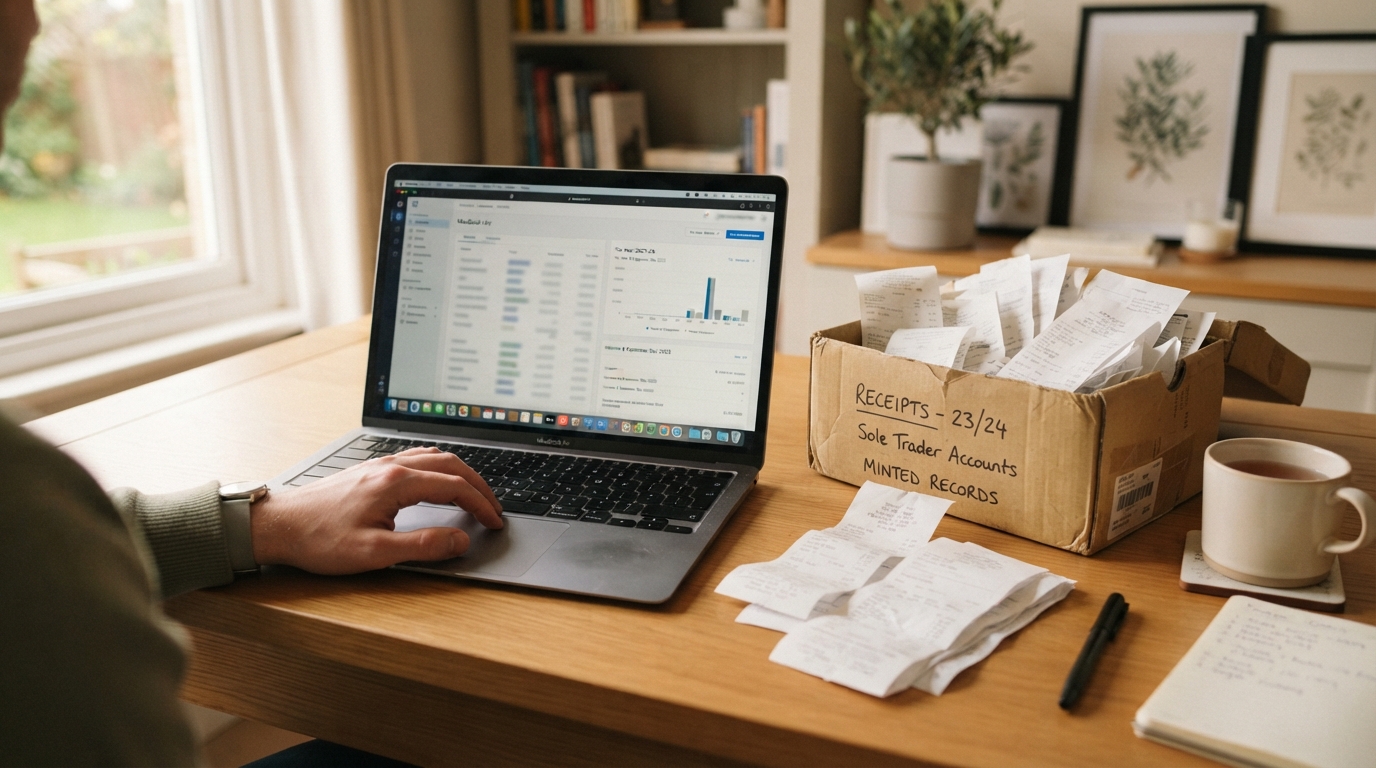
Most sole traders who fall behind do not have a filing cabinet. They have a carrier bag of receipts, a business current account that doubles as a personal one, and a growing sense that the pile has become impossible to untangle. It has not. Turning that mess into filed returns is a mechanical sequence, and the same work leaves you with the digital records that catching up on years of arrears and the new filing regime both now require.
The order matters. Gather everything into one place, categorise it consistently, reconstruct the years where the paperwork has gaps, then keep the result in a digital form. Skipping straight to the software, before the underlying records are in order, is the most common way these catch-ups stall.
What HMRC actually needs to see
A sole trader has to be able to show how the profit figure on each return was worked out. In practice that means a record of business income and a record of allowable business expenses for each tax year, backed by the underlying documents: bank statements, invoices, receipts, and a note of anything used partly for private purposes. The Low Incomes Tax Reform Group sets out plainly what counts as adequate business records, and the bar is lower than most people fear. You do not need a bookkeeper-grade ledger. You need a defensible trail from your bank and receipts to the numbers on the return.
Those records have to be kept, too. The rule for the self-employed is to keep business records for at least five years after the 31 January submission deadline for the relevant tax year. Where a return is filed more than four years late, the records have to be kept for fifteen months after you send it. For a multi-year catch-up that means the paperwork you assemble now is not disposable once the returns are in; it is the evidence base if HMRC later asks a question.
Get My Quote
Ready to get started? Tell us what is outstanding and we will send a fixed written quote within 48 hours, with no obligation.
Gather everything into one place first
Before categorising anything, pull the source documents together. For a sole trader the core sources are consistent from one trade to the next, and most can still be recovered years later:
- Bank statements for every account money passed through, including the personal account if the business used it. Banks can supply several years of historic statements on request.
- Payment platform reports. Stripe, PayPal, Square, GoCardless and similar all provide annual transaction summaries that give a clean view of platform-routed takings.
- Marketplace year-end reports. eBay, Etsy, Amazon and Vinted now report seller data to HMRC above set thresholds, so reconcile to their figures rather than guessing.
- The physical receipts, invoices and any takings book or diary, however incomplete.
The point of gathering first is that you cannot see the shape of the year until everything is in front of you. A receipt found late that pushes an expense into a different year, or a second account nobody mentioned, changes the numbers. Assembling the full picture before touching a spreadsheet stops the reconstruction being redone twice.
Separating business from personal in a mixed account
The single biggest reconstruction task for a sole trader is untangling a bank account that was never purely a business one. The method is line by line. Every credit is either turnover or it is not: customer payments are income, while refunds, transfers from savings, loans and personal gifts are not. Every debit is either an allowable business cost or private spending. Consistency across the years matters more than perfection on any single line, because HMRC accepts a well-documented categorisation far more readily than a set of round-number estimates with no working behind them.
Where records are genuinely lost, estimates are allowed
If receipts or statements cannot be recovered, HMRC lets you file using estimated figures, your best honest guess, or provisional figures where actuals will follow. You must tell HMRC on the return which you have used. This keeps a catch-up moving instead of stalling on a year where the paperwork is gone.
The expenses people forget when reconstructing
Reconstructing from old records almost always surfaces deductible costs that were never tracked, and each one reduces the tax due for that year. Two are worth claiming through the simplified flat rates HMRC publishes, because they need no receipts. Working from home can be claimed at a flat £10 a month for 25 to 50 hours of business use, £18 for 51 to 100 hours, and £26 for 101 hours or more. Business mileage in your own car or van can be claimed at 45p a mile for the first 10,000 miles in the year and 25p a mile after that, or 24p a mile for a motorcycle, reconstructed from diary entries, fuel receipts and customer locations.
- Use of home as office and business mileage, via the flat rates above.
- Tools, equipment and software, including items bought shortly before the trade formally started.
- Professional subscriptions, trade publications, and training that maintained an existing skill.
- Bank charges on the account used for the business, business insurance and accountancy fees.
- Materials, postage and packaging often paid in cash or on a personal card and missed on the first pass.
A thorough reconstruction routinely recovers a meaningful slice of forgotten expenses, which is why rushing this stage is a false economy. It also matters where income was never declared at all: undeclared self-employment brings its own failure to notify exposure, and the cleaner the expense side, the lower the profit the penalties are calculated on.
Leaving the books in an MTD-ready shape
Once the years are reconstructed, keep the result digitally rather than back in a carrier bag. This is no longer only good practice. Making Tax Digital for Income Tax requires sole traders and landlords with qualifying income over £50,000 to keep digital records and send quarterly updates from 6 April 2026, with the threshold dropping to £30,000 from April 2027 and £20,000 from 6 April 2028. Qualifying income is gross income from self-employment and property before any expenses or allowances, so it is the turnover figure, not the profit, that decides whether you are in scope.
The prior-year returns in a catch-up can generally still be filed through the existing Self Assessment system rather than under MTD, so the immediate job is getting the outstanding years in. But the reconstruction you do now is the natural moment to move onto software, because the categorised bank data and expense records transfer straight into it. Doing the catch-up and the digital onboarding as one exercise, rather than reconstructing on paper and rebuilding again later, saves the work twice over. Where the backlog runs to several years, filing them in the right sequence is a job in itself, and a specialist who handles multiple years of returns can carry the reconstruction and the MTD setup together.
Common questions about reconstructing sole trader records
My bank only holds a few years of statements. Can I still file older years?
Yes. Banks can often retrieve older statements on request, sometimes for a fee, and payment platforms hold their own history. Where a period genuinely cannot be reconstructed, HMRC accepts honest estimated or provisional figures, provided you flag on the return that you have used them.
Do I have to buy accounting software to catch up?
Not to file the outstanding prior years, which can usually go through the normal Self Assessment route. You will need Making Tax Digital compatible software going forward once your qualifying income crosses the relevant threshold, so if you are close to it, setting the software up during the catch-up avoids doing the groundwork twice.
Is it too late to claim expenses on returns from several years ago?
Legitimate business expenses belong in the year they were incurred and reduce that year's profit, so reconstructing them for a late return is exactly what you should do. The constraint is evidence rather than time: the better documented the cost, the more robust the claim if HMRC reviews it.
Years of records to turn into filed returns?
We reconstruct your income and expenses from whatever you have, file the outstanding years, and set the books up digitally for Making Tax Digital. Fixed written quote, confidential, no obligation.